

Why healthcare has become a major AI use case
Healthcare produces enormous amounts of complex information: medical images, patient histories, lab results, insurance records, scheduling data, and clinical notes. That makes it one of the clearest environments for applied AI. When used well, AI can help clinicians and healthcare teams interpret information faster, surface risks earlier, and reduce the repetitive work that slows down patient care.
The important point is that AI in healthcare is not only about futuristic robots or replacing doctors. Much of the real value comes from decision support, documentation support, workflow improvement, and better prioritization. In other words, AI becomes useful when it helps people make better decisions and move work forward more efficiently.
Diagnostics is one of the strongest early wins
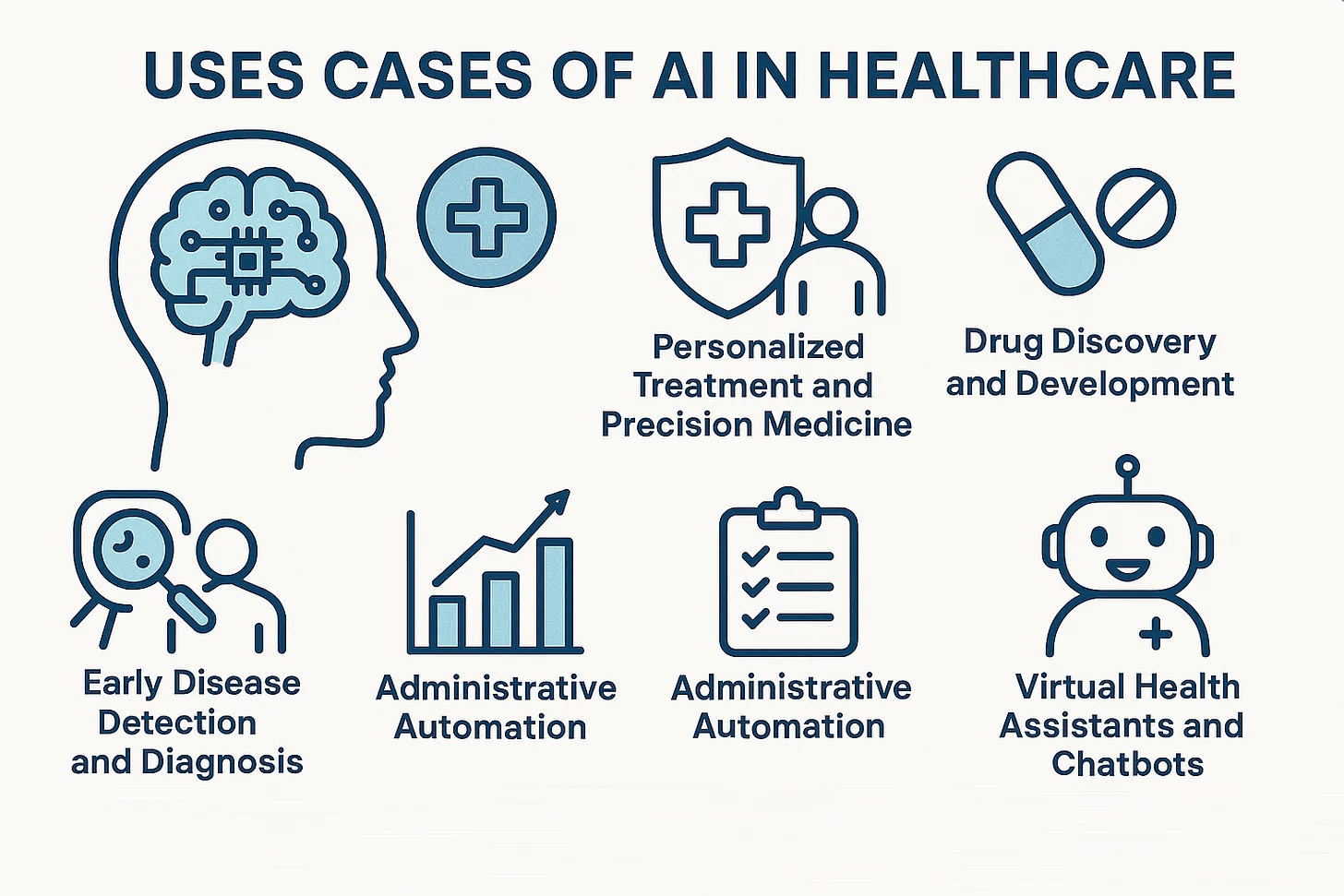
One of the most visible areas of impact is diagnostics. AI systems can assist with reading imaging data such as X-rays, CT scans, and MRIs, helping teams detect patterns, anomalies, and possible early warning signs with greater consistency. Similar approaches are also showing value in pathology and other data-heavy diagnostic contexts where signal detection matters.
Used responsibly, this kind of support can help speed up review, improve triage, and reduce the chance that subtle indicators are missed. The best framing is not that AI replaces expert clinical judgment, but that it can strengthen it by surfacing additional insight at the right time.
Personalized treatment is becoming more practical
Another major area of progress is treatment personalization. AI can combine medical history, current symptoms, prior outcomes, and in some cases genetic or lifestyle information to support more tailored treatment decisions. That is especially relevant in areas such as oncology, chronic disease management, and any context where one-size-fits-all care leads to weaker outcomes.
The value of this approach is not simply customization for its own sake. It is the ability to recommend interventions with better fit, fewer unnecessary side effects, and stronger alignment to the patient’s actual condition. As models improve and more data becomes available, this decision-support layer is likely to become more common across care pathways.
Operational efficiency may be the quietest high-impact use case
Not all healthcare AI value happens in direct clinical decisions. Some of the most immediate gains come from operations. AI can help with scheduling, patient communication, claims support, documentation, routing inquiries, summarizing records, and managing high-volume administrative workflows that consume staff time.
These improvements matter because operational bottlenecks directly affect patient experience. A system that reduces documentation load, shortens response times, or helps staff find the right information faster can improve care quality indirectly by giving professionals more time and attention for the work only humans can do.
| Healthcare Area | AI Support Role | Expected Benefit |
|---|---|---|
| Diagnostics | Pattern detection and image review support | Faster triage and more consistent review |
| Treatment Planning | Decision support using patient context | More personalized recommendations |
| Operations | Scheduling, documentation, claims, communication | Lower admin burden and smoother patient flow |
The real constraints are privacy, bias, and governance
The opportunity is significant, but healthcare is also one of the highest-stakes AI environments. Patient privacy, model bias, regulatory uncertainty, and accountability cannot be treated as side issues. If training data is incomplete or unrepresentative, AI systems can produce uneven outcomes across different patient groups. If governance is weak, organizations can move too quickly and create trust problems that are hard to reverse.
That is why implementation has to include human review, bias testing, strong data protection practices, and clear accountability for how AI outputs are used. In healthcare, good AI adoption is never just about the model. It is about whether the surrounding system is safe, fair, and operationally mature enough to use it responsibly.
| Risk Area | What Can Go Wrong | Good Practice |
|---|---|---|
| Privacy | Sensitive patient data is exposed or mishandled | Use strict access controls and strong data governance |
| Bias | Model performance varies across patient groups | Audit datasets and monitor fairness across populations |
| Governance | Teams rely on AI without clear accountability | Keep human review and explicit decision ownership |